Courses previously taught at the University of Tartu unless specified otherwise
- PHILOSOPHICAL METHODOLOGY (FLFI.04.018)
With et al. /Spring 2017/
The course gives an overview of various philosophical methods and asks if there is something that is distinctive about them when compared to scientific methods. The students will meet the representatives of different chairs in the department and will get a glimpse of different methods practiced in various fields of philosophy such as history of philosophy, practical philosophy, theoretical philosophy and philosophy of science.
- INTRODUCTION TO METAPHYSICS (FLFI.04.032, in English)
/Fall 2016/Fall 2017/
Metaphysics that deals with the nature and the existence of various entities as well as with the relations between them, is the core area of the theoretical philosophy. This course approaches this subject from the analytic perspective and provides an overview of the basic categories of being, of the various relations between entities and of some central themes in metaphysics such as time, causation and free will. The objectives are 1. to introduce the basic concepts, theories and arguments in metaphysics. 2. to prepare students for advanced courses in metaphysics.
Having passed this course, students should 1. know the basic concepts and theories of contemporary analytic metaphysics; 2. be able to explain them in detail; 3. be able to discuss metaphysical issues.
- RESEARCH SEMINAR ON EMOTIONS (FLFI.00.087)
With Margit Sutrop and Vivian Bohl /Fall 2016/
The broader aim of the research seminar is to develop independent and team research skills and thorough theoretical knowledge in the area of specialisation. MA students will be integrated into the research group on disagreements: they will know how to participate in academic discussions, how to provide and receive critical and constructive feedback and how to work on a solution for a philosophical or interdisciplinary problem in a team.
In Autumn 2016, the focus of the seminar is on the nature emotions.
- RESEARCH SEMINAR ON DISAGREEMENTS (FLFI.00.087)
With Dr. Uku Tooming /Spring 2016/
The broader aim of the research seminar is to develop independent and team research skills and thorough theoretical knowledge in the area of specialisation. MA students will be integrated into the research group on disagreements: they will know how to participate in academic discussions, how to provide and receive critical and constructive feedback and how to work on a solution for a philosophical or interdisciplinary problem in a team.
In Spring 2016, the focus of the seminar is on introspective disagreements. Can there be disputes over what is given introspectively? What is the source of such disputes? How can they be solved?
- PHILOSOPHY OF MIND READING GROUP (FLFI.04.052)
Vaimufilosoofia lugemisgrupp /Fall 2014/Spring 2015/Fall 2015/Spring 2016/Spring 2017
The Philosophy of Mind Reading Group convenes in order to read texts in philosophy of mind that are of current interest. The aim is to keep the students up to date with current issues in philosophy of mind.
Having passed the course, the student has improved his or her ability to analyse philosophical texts, his or her presentations skills and is familiar with a current topic in philosophy of mind.
- PHILOSOPHY OF TEMPORAL EXPERIENCE
Compact course, April 2015, Ruhr-Universität Bochum, Germany
The course will focus on different contemporary approaches to the experience of time. It covers main phenomenological, analytic and neurophilosophical accounts of temporal experience. The following topics will be discussed: main accounts of the experience of time (Cinematic, Retentional and Extensional models), attempts to naturalize phenomenology of time consciousness, the relation between brain time and subjective time, temporal illusions.
Download syllabus
- TEADVUS JA SURM: VARAUUSAEGSED NING NÜÜDISAEGSED ETTEKUJUTUSED (FLFI.04.042)
Consciousness and Death: Early Modern and Contemporary Ideas /Spring 2014/Spring 2016/. With R. Jakapi
The course aims to provide an overview of the ideas about what happens to human consciousness after death. We approach the issue from the historical, naturalistic and paranormal perspective. The first half of the course covers early modern ideas about the post-mortal state of human soul; the second half gives an overview of present-day naturalistic and paranormal theories about the near-death (NDE) and the out-of-body (OBE) experiences.
Having passed the course, the student
1. knows main early modern conceptions of the state of the soul after death and our contemporary accounts about near-death and out-of-body experiences.
2. can assess how scientific these accounts are.

- SISSEJUHATUS METAFÜÜSIKASSE (FLFI.04.032)
Introduction to Metaphysics /Fall 2012/Fall 2013/Fall 2014/Fall 2015/
Metaphysics that deals with the nature and the existence of various entities as well as with the relations between them, is the core area of the theoretical philosophy. This course approaches this subject from the analytic perspective. A part of the course is devoted to the basic categories of being – universals, particulars, facts, events and propositions. In addition, the course deals with various relations between these entities and with some central concepts in metaphysics such as truth-making, ontological commitment, possible worlds, constitution, time and persistence. The objectives are 1. to introduce the basic concepts, theories and arguments in metaphysics. 2. to prepare students for advanced courses in metaphysics.
Having passed this course, students should 1. know the basic concepts and theories of contemporary analytic metaphysics; 2. be able to explain them in detail; 3. be able to discuss metaphysical issues.
Download syllabus
- AEG: KOGEMUS JA METAFÜÜSIKA (FLFI.04.037)
Time: Experience and Metaphysics /Spring 2012/
The general aim of the course is to provide overview of time as a research topic in philosophy of mind and in metaphysics. The course covers both subjective and objective time and the relationship between them.
Is consciousness temporal? What is the specious present?
The first part of the course is devoted to the experience of time and the main accounts of it, mainly the Extensional and the Retentional models.
Does time pass? Is real only what happens at present?
The second part of the course is dedicated to time in contemporary metaphysics. We cover the tensed theory (the A Theory) and the tenseless theory (the B Theory) as well as positions about the temporal becoming and existence: Presentism, Eternalism and the Growing Block View.
Having passed this course, students 1) know the main philosophical accounts of the experience of time and the metaphysics of time; 2) are able to explain them in detail; 3) have practised philosophical writing. Syllabus
- SISSEJUHATUS VAIMUFILOSOOFIASSE (FLFI.04.014)
Introduction to Philosophy of Mind /Fall 2011/Fall 2012/Fall2013/Fall 2014/Fall 2015/Spring 2017/ Fall 2017
The philosophy of mind is among the central fields in contemporary philosophy. The introductory course will provide an overview of its main concepts, themes and arguments, focussing mainly on various solutions to the mind-body problem. Having passed the course, the student 1) masters the most important concepts in the philosophy of mind; 2) knows the main metaphysical positions in the area; 3) is able to work with the original papers of the philosophy of mind.
Download syllabus for 2011
- PHYSICALISM AND CONSCIOUSNESS (FLFI.04.033)
Füsikalism ja teadvus /Spring 2011/ With Prof. Daniel Cohnitz
The course introduces the contemporary discussion over the prospects of a physicalist approach to consciousness. We cover main arguments against physicalism such as Kripke’s argument, which has been an important source for later „zombie-discussions“ and Frank Jackson’s „Mary argument“. We also look in depth at two defences of physicalism by John Perry and David Papineau, respectively, that both relate to these arguments and which make use of the idea that we use phenomenal concepts to refer to phenomenal states.
Download syllabus
- FENOMENOLOOGIA JA VAIMUFILOSOOFIA (FLFI.04.029)
Phenomenology and Philosophy of Mind /Fall 2009/ With Vivian Bohl
The aim of the course is to introduce phenomenological philosophy of mind. We provide an overview of an actual theme in contemporary philosophy: phenomenological approaches (Husserl, Heidegger, Merleau-Ponty, Sartre) to philosophical issues about the mind, supplemented by research results from current cognitive science. The topics covered include: methodology for phenomenological investigation of the mind, consciousness, self-consciousness, time consciousness, personal identity, intentionality, embodiment and action.
Download syllabus
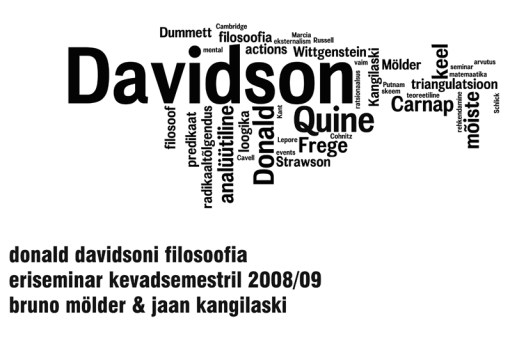
- DONALD DAVIDSONI FILOSOOFIA (FLFI.04.019)
The Philosophy of Donald Davidson /Spring 2009/ With Jaan Kangilaski
Donald Davidson is among the most eminent and influential philosophers nowadays. His views, seemingly scattered along different areas, in fact make up a cohesive philosophical system. This course aims to introduce Davidson’s philosophy in its unity, encompassing both metaphysical and epistemological topics and especially the themes in the philosophy of language that are the centerpiece of Davidson’s account. The topics that will be covered include mental causation and action explanation, the nature of events, truth and knowledge, truth-conditional account of meaning, interpretation and rationality.
Download syllabus
- SISSEJUHATUS EPISTEMOLOOGIASSE (FLFI.04.013)
Introduction to Epistemology /Fall 2008/Fall 2009/Open University Spring 2009/OU Fall 2010/Fall 2010/OU Fall 2012/
Epistemology that deals mainly with the problems of knowledge, perception and justification is one of the central fields of the theoretical philosophy. This course is an analytic introduction to contemporary epistemology with excursions to the epistemological problems throughout the history of philosophy. The course introduces the main topics in epistemology: the concepts and accounts of knowledge and justification, accounts of perception, scepticism, memory and a priori knowledge.
The objectives are (1) to introduce the basic concepts, theories and arguments in epistemology; (2) to prepare students for advanced courses in epistemology. Having passed this course, students
1. know the basic concepts and theories of epistemology;
2. are able to explain them in detail;
3. can discuss epistemological issues.
Download syllabus for 2008, syllabus for 2009
- EXPLANATORY GAPS (FLFI.04.010)
Seletuslikud lõhed /Spring 2008/ With Prof. Daniel Cohnitz
From the very advent of modern science, its progress is intimately connected with shaking and altering the ways human beings conceive of themselves and their place in the world’s order of things. At present time, modern psychology and neuroscience confronts us again with results that apparently are at odds with our “folk-theoretic”, or a priori understanding. The question is whether our folk theoretic understanding just turns out to be erroneous (so that we have to replace our common sense or “folk” notions with the “scientific” ones), or whether the apparent clash needs to be resolved in a different way, preserving the (scientific) legitimacy of our folk theoretic conceptions. The course focuses on one expression of this clash – the notion of an explanatory gap. We are faced with an explanatory gap when the set of truths that makes up the intended explanans (e.g. the truths of neuroscience) does not entail the explanandum, the phenomenon we want to explain (e.g. phenomenal consciousness). In order to find a better understanding of what is going on in cases of explanatory gaps, we will have a look at theories of scientific explanation, theories of ontological elimination, and theories about the status of folk-conceptions and their development.
Download syllabus
- SISSEJUHATUS FILOSOOFIASSE (FLFI.00.001)
Introduction to Philosophy /Spring 2008/Spring 2009/Spring 2010/Spring 2011/Spring 2012/Spring 2013/Spring 2014/Spring 2015/Spring 2016/Spring 2017 With Dr. Roomet Jakapi and Dr. Marek Volt
Overview of the central concepts, problems and domains of philosophy. Philosophical problems and solutions.
The objectives: 1. To give an overview of the central concepts, problems and theories in different domains of philosophy; 2. Developing the ability of critical thinking and improving argumentation skills.
Syllabus for 2008; Syllabus for 2009
- AJATAJU (FLFI.00.059)
The Experience of Time /Fall 2007/
The course will provide an overview of different contemporary approaches to the experience of time. It covers phenomenological, neurophenomenological, neurophilosophical as well as analytic approaches. In this respect, it would suit to students with various backgrounds.
Students who pass this course acquire an overview of the main issues in studying the experience of time. In addition, the ability to analyse philosophical texts, the ability of philosophical reasoning and presentation skills are developed.
Download syllabus (in Estonian)
- PÕHJUSLIKKUS, INTENTSIONAALSUS JA TEADVUS: REDUKTSIOONI MÕISTATUSED (FLFI.03.072)
Causation, Intentionality and Consciousness: Riddles of Reduction /Spring 2007/
Contemporary philosophy of mind is largely striven by the ideal of reduction. This course centers on three mental phenomena and on the attempts to provide their reductive accounts – the place of mental causation in the physical world, the naturalisation of intentionality and the prospects for a physicalist account of consciousness.
This course aims to provide an overview of main issues in the contemporary philosophy of mind, to cultivate analytic competence in reading original philosophical works and to develop the skill of philosophical discussion. The course is suitable for upper-level undergraduates, master and doctoral students in philosophy and for anyone interested in philosophy of mind. There are no prerequisite courses, but prior acquaintance with the course “Introduction to the philosophy of mind and language” would be useful.
Download syllabus (in Estonian)
- THEORIES AND CONCEPTIONS OF TRUTH (FLFI.03.070)
Tõeteooriad /Fall 2006/ With Prof. Daniel Cohnitz and Jaan Kangilaski
The basis of our discussion in this seminar is the book “Conceptions of Truth” (Oxford UP 2005) by Wolfgang Künne.
The synopsis of the book reads: “Truth is one of the most debated topics in philosophy; Wolfgang Künne presents a comprehensive critical examination of all major theories. “Conceptions of Truth” is organized around a flow-chart comprising sixteen key questions, ranging from Is truth a property? to Is truth epistemically constrained? Künne expounds and engages with the ideas of many thinkers, from Aristotle and the Stoics, to Continental analytic philosophers like Bolzano, Brentano, and Kotarbinski, to such leading figures in current debates as Dummett, Putnam, Wright, and Horwich. He explains many important distinctions (between varieties of correspondence, for example, between different conceptions of making true, between various kinds of eternalism and temporalism) which have so far been neglected in the literature. Künne argues that it is possible to give a satisfactory ´modest´ account of truth without invoking problematic notions like correspondence, fact, or meaning. And he offers a novel argument to support the realist claim that truth outruns justifiability.”
The seminar is mainly aimed at the advanced full-time resident students in philosophy, also at the students participating in the masters’ and doctors’ programs. The assessment is done on the basis of presentations on parts of the book and the minutes (protocols) of the discussions.
- SISSEJUHATUS EPISTEMOLOOGIASSE JA ANALÜÜTILISSE METAFÜÜSIKASSE (FLFI.03.050)
Introduction to Epistemology and Analytical Metaphysics /Spring 2006/Spring 2007/Spring 2008/ Open University Spring 2008/Open University Spring 2009
An analytic introduction to contemporary epistemology and metaphysics. The first part of the course covers various topics in epistemology: basic concepts, accounts of knowledge and justification, theories of perception, scepticism, a priori knowledge and naturalised epistemology. The second part is devoted to metaphysics with an emphasis on the basic categories of being – universals, particulars, facts and events. Various accounts of their nature and identity conditions are discussed.
The primary objective of the course is to introduce basic concepts, theories and arguments of contemporary epistemology and metaphysics. The secondary aim is to prepare students for more advanced courses in epistemology and metaphysics by providing basic methodology and cultivating the skill of critical thinking.
Syllabus for 2006; Syllabus for 2007; Syllabus for Spring 2008; Syllabus for Open University 2008; Syllabus for Open University 2009
- VAIMUTEOORIA: FILOSOOFILISED JA PSÜHHOLOOGILISED ASPEKTID (FLFI.03.065)
Theory of Mind: Philosophical and Psychological Aspects /Fall 2005/
It is a common-sense platitude that we understand the intentions of others and routinely ascribe beliefs and desires to other people. But what makes this possible? For instance, do we apply an implicit theory of mind to interpret others? Are there any other explanations? How do the required concepts and abilities develop? During the last twenty years, besides increased philosophical interest, there has been an explosion of research of these issues in developmental psychology, ethology, psychopathology, social psychology. This seminar is devoted to the philosophical study of psychological readings. We cover such topics as the nature of folk psychology, simulation theory, theory of mind in nonhuman primates, autism, with a special emphasis on developmental studies.
Download syllabus (in Estonian)
- VAIMUFILOSOOFIA PEATEEMAD (FLFI.02.092)
Main Themes in Philosophy of Mind /Fall 2004/
The course provides an overview of main themes in philosophy of mind. Each lecture introduces a different theme and the following seminar will enable to centre more closely on a special question. The covered topics include mind-body problem, intentionality and mental content, the nature of folk-psychology, qualia, mental causation, rationality and self-knowledge.
Download syllabus (in Estonian)
- ANALÜÜTILINE FILOSOOFIA TEKSTIDES (US00.02.018 )
Methods of Analytical Philosophy /Fall 1997/
The course attempts to provide an understanding of the characteristic ways of reasoning in analytic philosophy. This is accomplished by means of a detailed analysis of representative texts of analytic philosophy.
The course consisted of 30 lectures; there were five lecturers – Jaan Kivistik, Margo Laasberg, Jaan Kangilaski, Anto Unt and me. I gave two lectures on the recent history of the philosophy of mind (behaviourism, identity theory, functionalism, eliminativism and neo-mysterianism) and two lectures on the problem of qualia.
 bruno mölder